Recently Meraki has released a new panel called «Roaming». This panel will show roaming history for every wireless client in your dashboard.
This is great, and something that I have missed. Meraki dashboard is getting better and better, maybe because Cisco+Meraki = TRUE and they are all now a big happy family helping each other.
But what kind of information can we see, and is things like roaming time based on the actual authentication frames or just when Meraki updates the client into a «run» state.
Below is a few pictures from my Macbook during my test, as always I used my WLANPi R4 with two adapters on 108@40 and 132@40. SSID is PSK.
The Roaming Panel
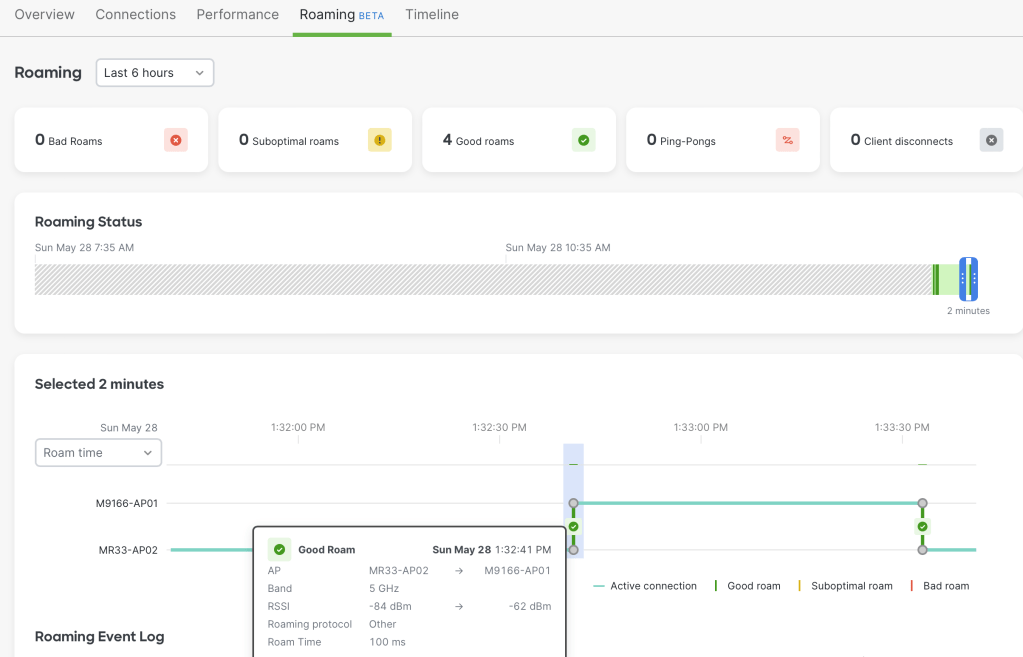
As you can see we have a few «blocks» with Bad, Suboptimal and Good roams, Ping-Pong where clients bounce between radios on different access-points and a client disconnects «block».
There is also one example here of a Good Roam, with a Roam Time of 100ms.
You can hover over each block to learn more, I will paste that information here:
Bad roams
• any roam where the roam time is >= 3000ms (3 seconds); or
• any roam where the RSSI on the arriving AP is >10dBm worse than the originating AP
Suboptimal roams
• any roam where the roam time is between 250ms and 3s; or
• any roam where the RSSI on the arriving AP is 6-10dBm worse than the originating AP
Good roams
• any roam where the roam time is <250ms and RSSI is better or no worse than 5 dBm than the originating AP
Ping pong clients
• any roam where the client is only roaming between two APs; and
• a minimum of 4 roams occur between these two APs; and
• roams are, at most, 60seconds apart
Client disconnects
• client device left the network or experienced a failed roaming attempt
Roaming Panel – Events
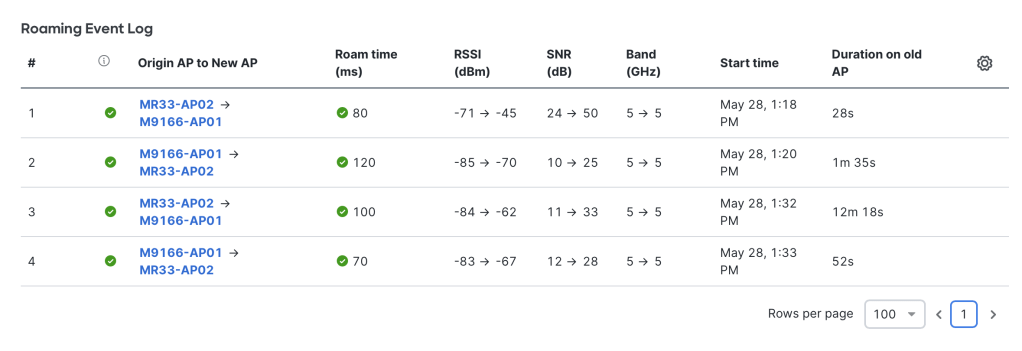
Below you have the event log that will show you all roaming events, and YES I also think that it is pretty weird that my MacBook Pro had to wait until the signal was at -85 before it decided to roam to the next access-point.
Roam Time
During Mobility Field Day 9, Peter MacKenzie asked a question about roam time, and I also wanted to know that in detail. So what I did was as do some roaming tests by capturing on two channels and walk around my house.
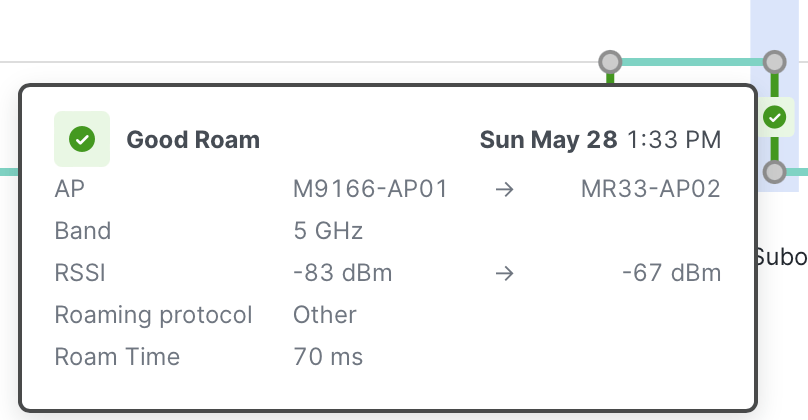
Let us look at one of them, here I roamed at -83dBm (I also saw that in Wi-Fi Signal, so that was pretty spot-on) and the entire «roam time» took 70ms
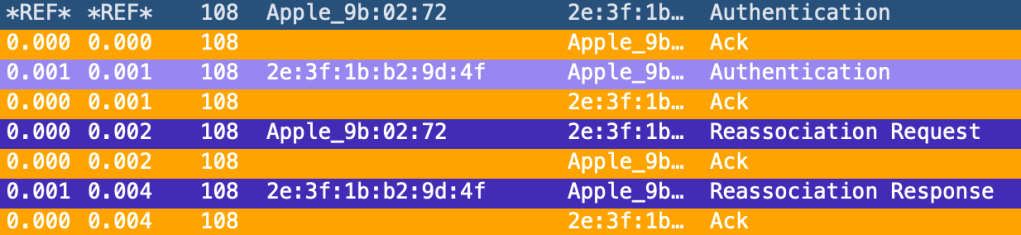
But actually it took 4ms
Let me take a look at a different roam, again why wait until -84dBm. (My lab is a mess, that is why – but still…)

This roam took 19ms
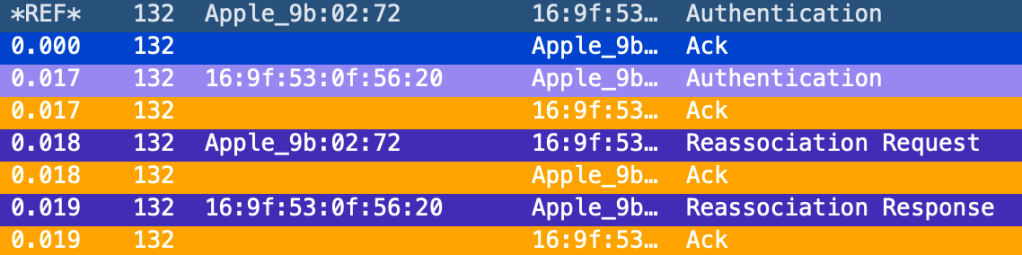
This is the same behaviour I see in the C9800 controller, AireOS controller and in DNAC. Their «Roam Time» is when the client is in RUN state on the controller, or in Meraki Dashboard in this case.
Here is a picture with more frames from the same roam, as you can see the client has started to send data frames before the «100ms» value that I see in Meraki Dashboard.
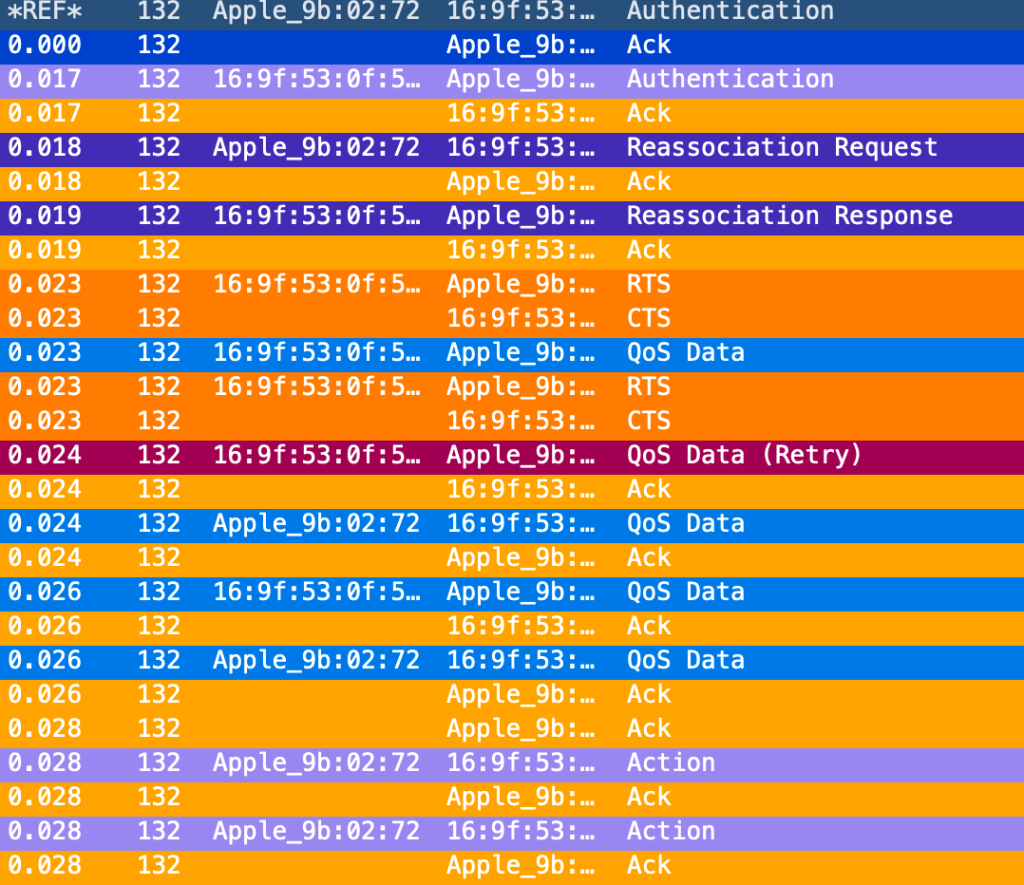
But, is this a good roam – yes, yes it is. Even if the value is a bit «off», both are still a good roam. The first one was 4ms (Meraki 70ms), the second was 19ms (Meraki 100ms). So it can see a difference, but my guess is that Meraki measure the time for when the client is fully onboarded, and not as specific as I do it here.
Summary
In this short blog post I have looked at two «Good Roams» from my MacBook in Meraki Dashboard. This test was done with a WLANPi over USB-C that was capturing on two 40MHz channel. I have then looked at the time it took from the first authentication frame, to the last ack after the Reassociation frame to measure roam time.
Please comment if you think this is a valid way to measure roam time, or not.
The roaming panel is still in beta, and I must say I really like it. Even if the values are a bit off, they are still all «Good Roams». I also just tested with a PSK network and will try with an Enterprise network next.
Did I answer your question Peter? No, I did not. Hopefully Meraki will answer us on how they see roam time.
But still, a great addition to the Meraki dashboard and we can clearly see that it can see the difference between a «slow» good roam and a «fast» good roam.


Hi Kjetil, any updates on how Meraki measure the roam time?
LikerLiker
Hi, no idea 🙂 Sorry, maybe as Meraki?
LikerLiker